About Us
It is a long established fact that a reader will be distracted by the readable content of a page when looking at its layout.

It is a long established fact that a reader will be distracted by the readable content of a page when looking at its layout.

Native immune, epithelial and stromal context
Cytokine, RNA and protein endpoints
Healthy, Crohn’s disease and ulcerative colitis tissue
Close the species gap before the clinic
AnaBios runs human colon tissue assays that show how your compound acts in viable, intact native human colon before it reaches patients. Our ex vivo colon biopsy assays support efficacy, proof-of-concept, mechanism-of-action, and safety and toxicity studies in inflammatory and fibrotic diseases, including IBD. Every study is built around your scientific questions, in healthy or diseased tissue from donors matched to your criteria.
Each study type addresses a different decision point in your program:
Human GI tissue assays can help identify potential safety and toxicity signals earlier in drug development, providing human-relevant insights to inform compound selection and risk assessment before clinical evaluation. These assays can also help investigate GI adverse events observed in clinical trials. By evaluating compound-induced changes in tissue viability, epithelial integrity, and inflammatory biomarkers, AnaBios provides human-relevant insights into potential mechanisms of GI tissue injury, supporting the interpretation of clinical safety findings and informing future development decisions.
Most GI work at AnaBios focuses on efficacy and mechanism of action, with selected safety and toxicity assessments added where your preclinical and clinical programs need them. Adding selected safety and toxicity endpoints to an efficacy design gives you .
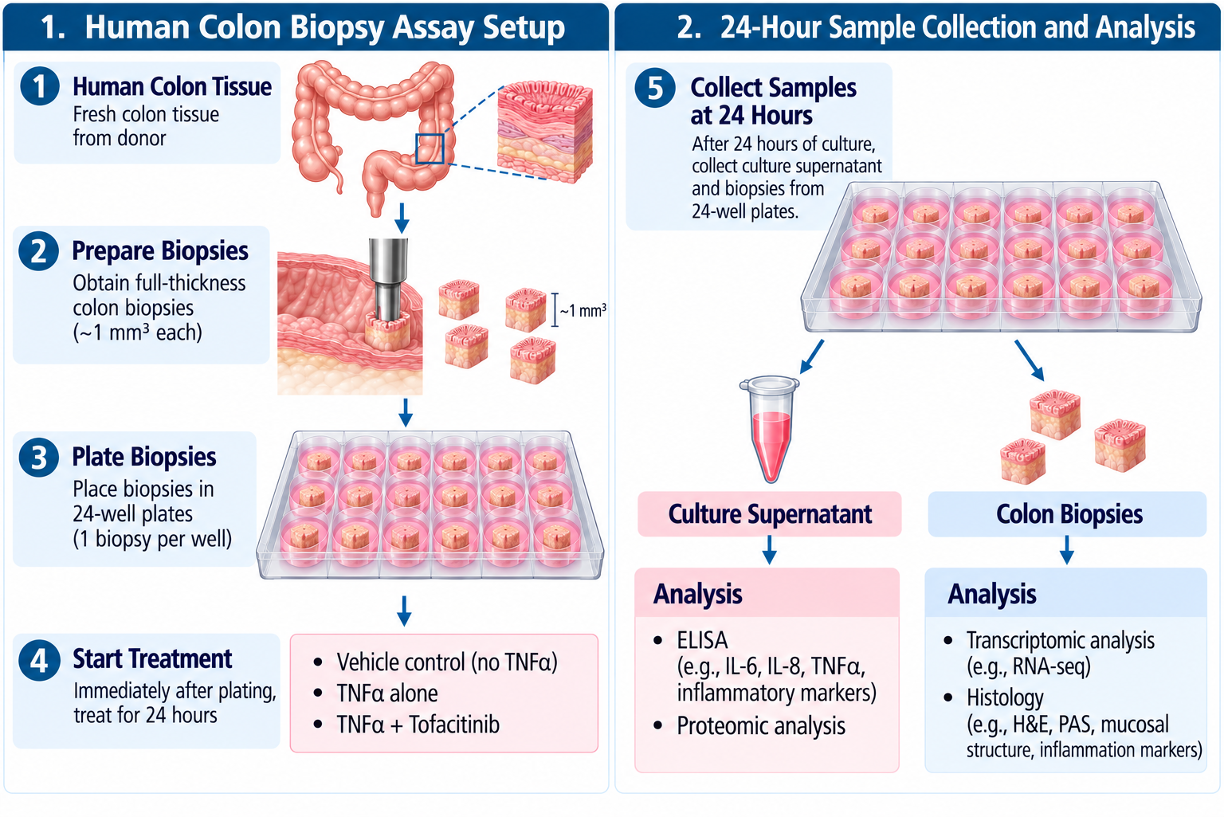
Studies use microdissected biopsies prepared from fresh human colon. Because the tissue stays intact, compound effects play out across the cell populations and signaling networks that shape GI disease, rather than in a single isolated cell type.
Biopsies are treated with your compounds alongside unstimulated and TNF-a-stimulated tissue controls. After 24 hours, culture supernatants are collected for biomarker analysis, and tissue samples are harvested for histological assessment and RNA and protein analysis. Inflammation related biomarkers, such as IL-6 and IL-8 are measured in both culture supernatants and tissue lysates to evaluate inflammatory responses and treatment effects.
For GI regions, disease tissue sourcing and donor data, see our human GI tissue page.
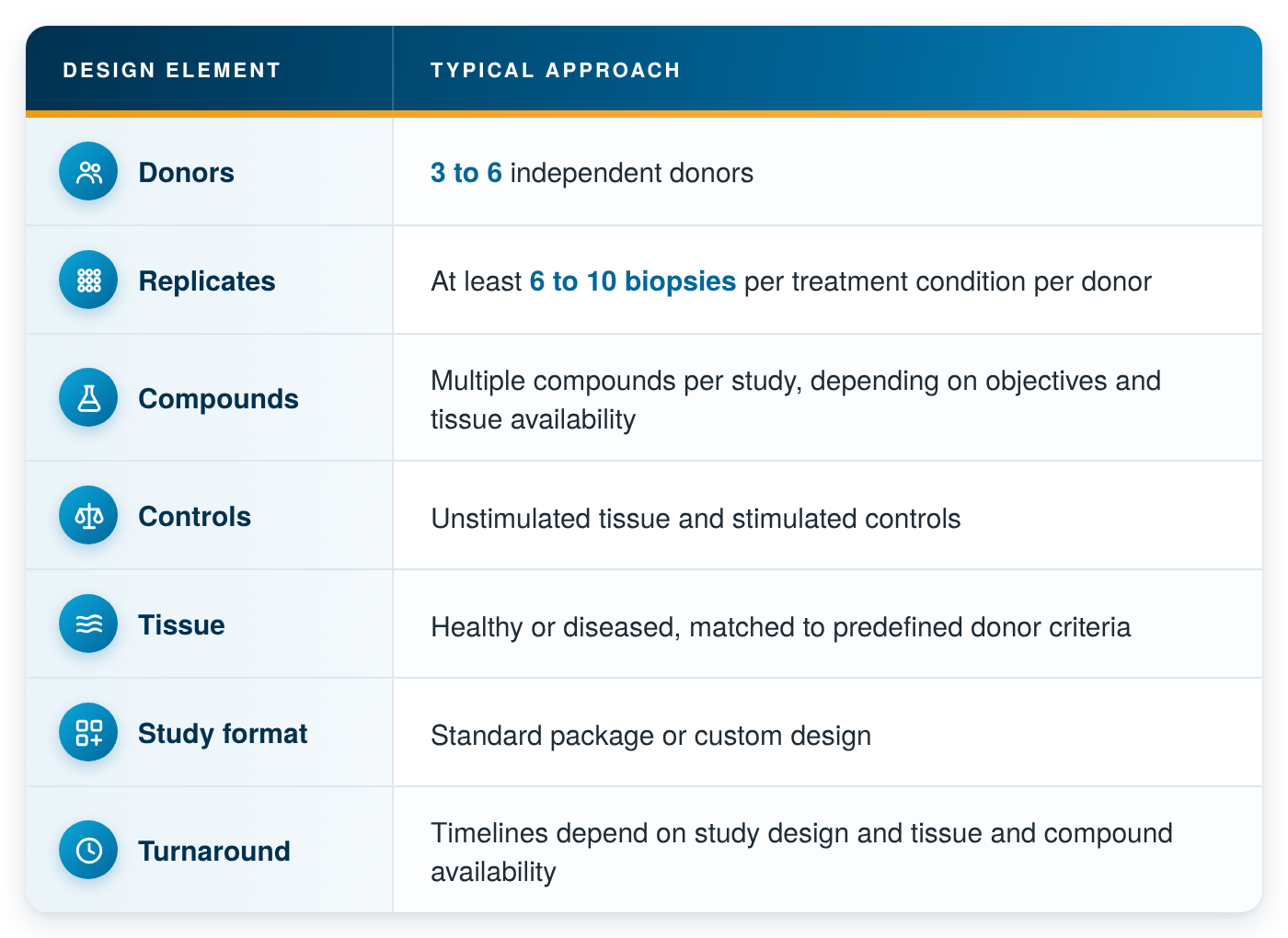
Multiple independent donors capture the biological variability a program face in a patient population, and replicate biopsies give each donor’s response statistical weight. Donor demographic and clinical data accompany every study, so results are stratified by disease state, medication history or demographics when they are interpreted.
Standard packages use established study configurations for programs that fit a common study design. Custom designs are built around your compounds, endpoints and experimental requirements, so the study answers specific questions instead of generic ones.
IBD, including Crohn’s disease and ulcerative colitis, is the most common focus, followed by GI safety assessment. Clients also bring programs in IBS-C, IBS-D, constipation, diarrhea and visceral pain.
The platform adapts to the indication and mechanism a program is studying. Running an IBD efficacy study in tissue from IBD donors, for example, assesses a compound against the disease state it’s meant to treat.
Yes. GI studies can be paired with other AnaBios platforms, such as DRG, lung, kidney or cardiac, in one integrated study design. That lets a program evaluates efficacy and off-target liabilities across organ systems in human tissue, without coordinating separate vendors. Ask about combined designs when you scope your study.
Human colon tissue data works alongside your existing models rather than replacing them. Cell lines and organoids give you throughput for screening. Rodent models add whole-organism context. Ex vivo human colon biopsies add the missing piece: how the compound behaves in human tissue, without species differences clouding the result.
Human colon tissue data adds the most value at three points:
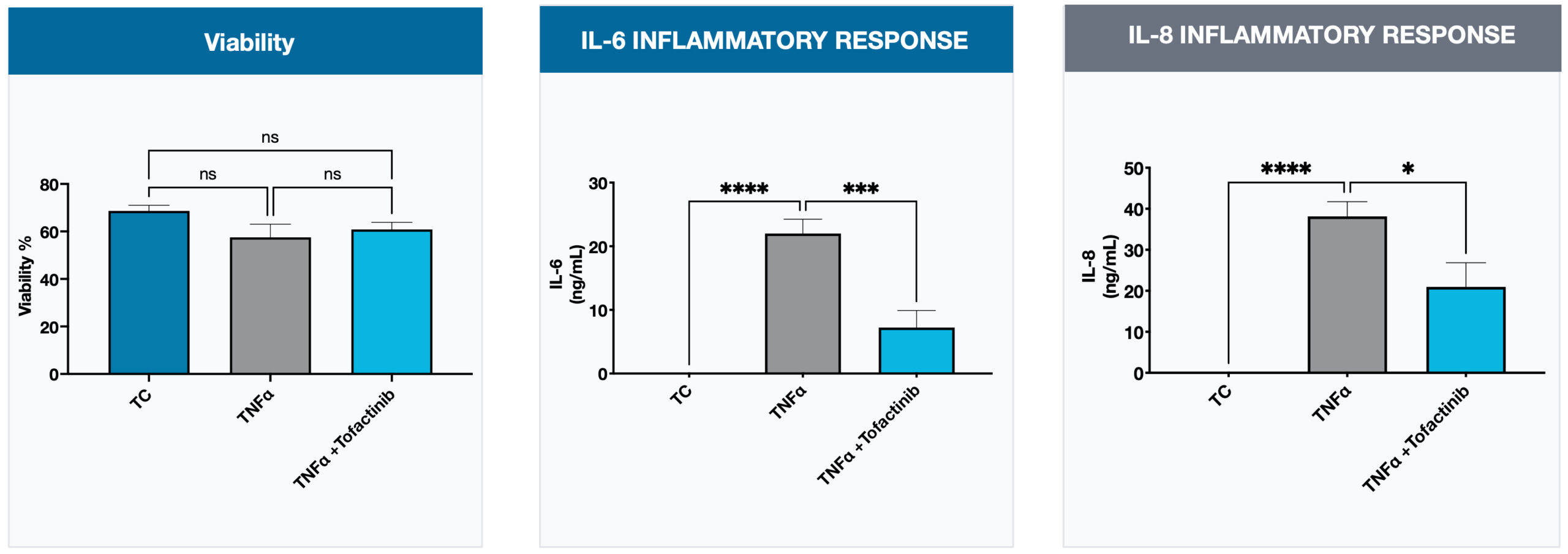
TNF-α stimulation increased IL-6 and IL-8 secretion in human colon biopsies, while co-treatment with tofacitinib suppressed these inflammatory responses without significantly affecting tissue viability after 24 hours.
Tell us your compound indication and the questions you need answered. Our scientific team will recommend a standard package or a custom design and confirm tissue availability for your study. Contact us to discuss your program and get started.
A human colon tissue study shows how a compound acts in intact human tissue, with immune, epithelial and stromal cells in their native context. That removes the species gap of rodent colitis models and adds tissue-level complexity that organoids and cell lines don’t fully capture. It complements those models rather than replacing them.
Biopsies are treated with your compounds alongside unstimulated and TNF-a-stimulated tissue controls. After 24 hours, culture supernatants are collected for biomarker analysis, and tissue samples are harvested for RNA and protein analysis. Inflammation related biomarkers, such as IL-6 and IL-8 are measured in both culture supernatants and tissue lysates to evaluate inflammatory responses and treatment effects.
Endpoints can be tailored to your target, mechanism and study objectives.
A typical AnaBios human colon tissue study uses 3 to 6 independent donors, with at least 6 to 10 biopsies per treatment condition per donor. Most studies test 2 to 5 compounds alongside unstimulated and stimulated controls.
Yes. Studies can run in tissue from donors with Crohn’s disease or ulcerative colitis, matched to predefined disease criteria. Availability depends on surgical volume and donor recruitment, so feasibility is confirmed during scoping. See our human GI tissue page for sourcing details.
Yes. Ex vivo human colon biopsy studies can characterize how a compound affects human GI tissue, providing mechanistic insight into clinical findings such as diarrhea or other GI adverse events. All work is conducted under client confidentiality.
Both. Standard packages use established study configurations. Custom designs are tailored to your compounds, endpoints and experimental requirements.
Yes. AnaBios can pair GI studies with its DRG and cardiac safety platforms in one integrated design, evaluating efficacy and safety endpoints across organ systems in human tissue.
Timelines depend on study design, tissue type and the availability of donors who meet your criteria.

To inquire about products, services and pricing, please go to the ‘Contact Us’ page by clicking the button below.