It is a long established fact that a reader will be distracted by the readable content of a page when looking at its layout.

Functional Assays › Pain-Related
Measure action potential firing, ionic currents and calcium transients directly in human sensory neurons.
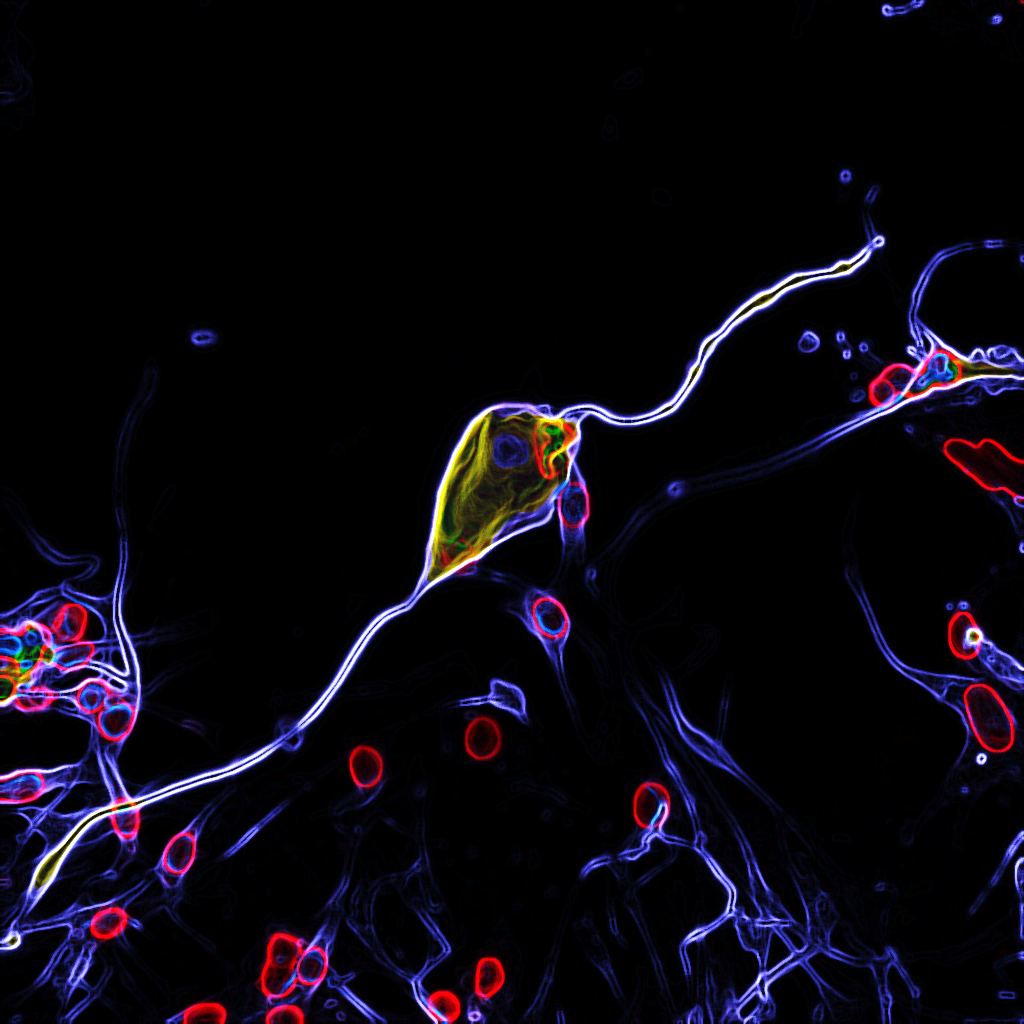
Choose a tab. Electrophysiology and calcium imaging in human DRG neurons.
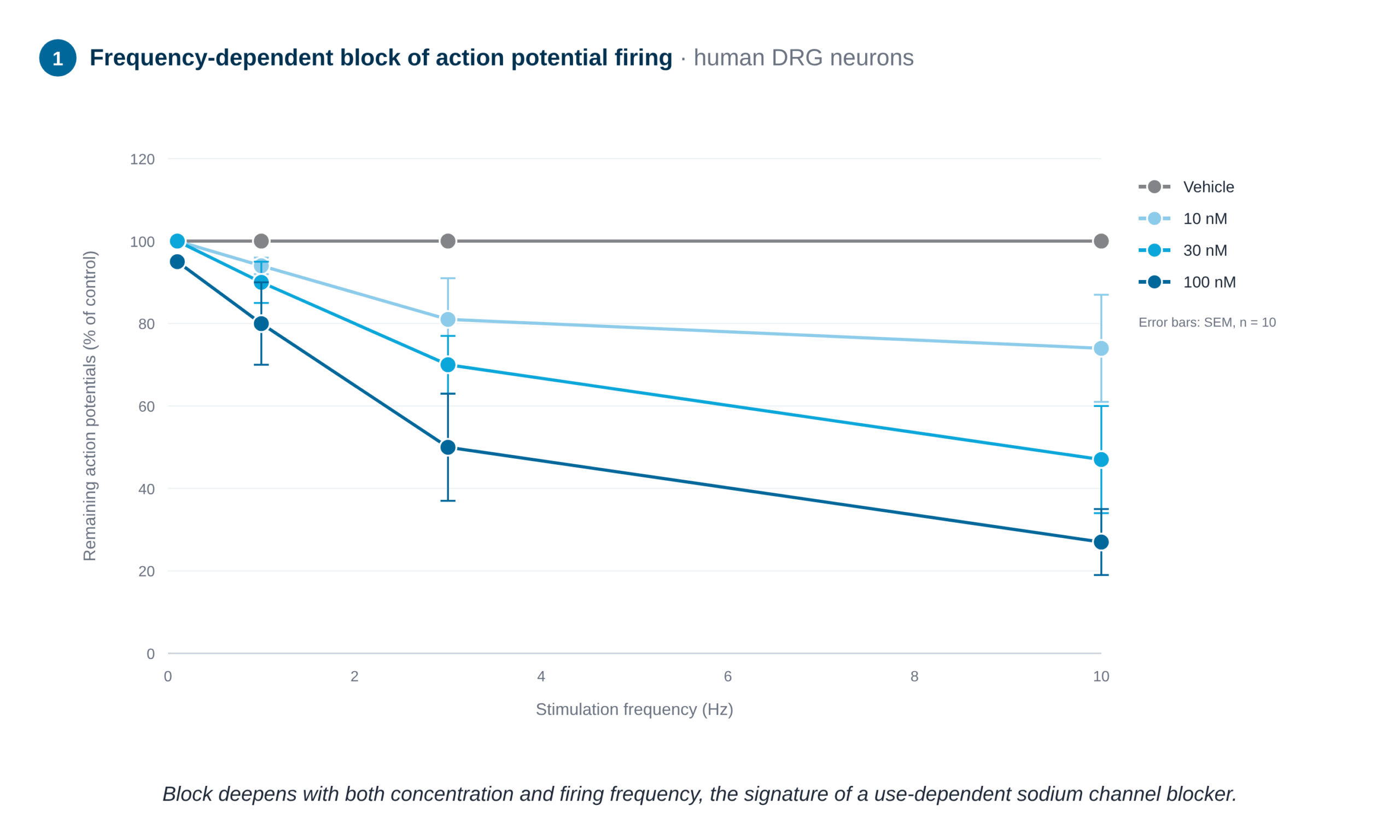
FIGURE 1
10 Cells
Carbamazepine and PF-05089771, two sodium channel antagonists, inhibited evoked action potential firing in a concentration- and frequency-dependent way across 0.1, 1, 3 and 10 Hz. Ten neurons per condition, error bars SEM.
FIGURE 2
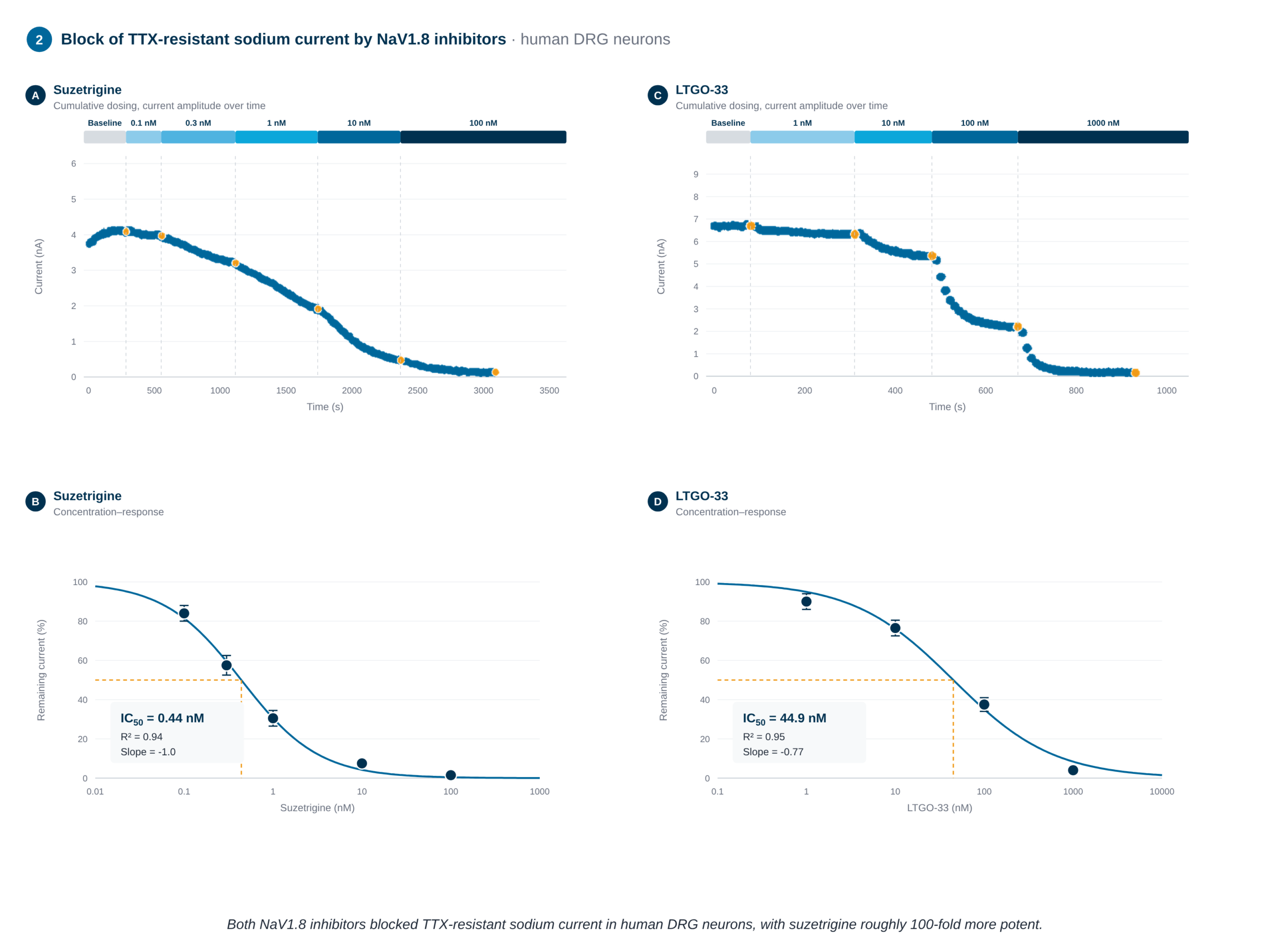
Cumulative dosing blocked TTX-resistant sodium current in cultured human DRG neurons. Suzetrigine gave an IC50 of 0.44 nM and LTGO-33 an IC50 of 44.9 nM, with currents elicited by a 50 ms pulse from a −80 mV holding potential.
FIGURE 3
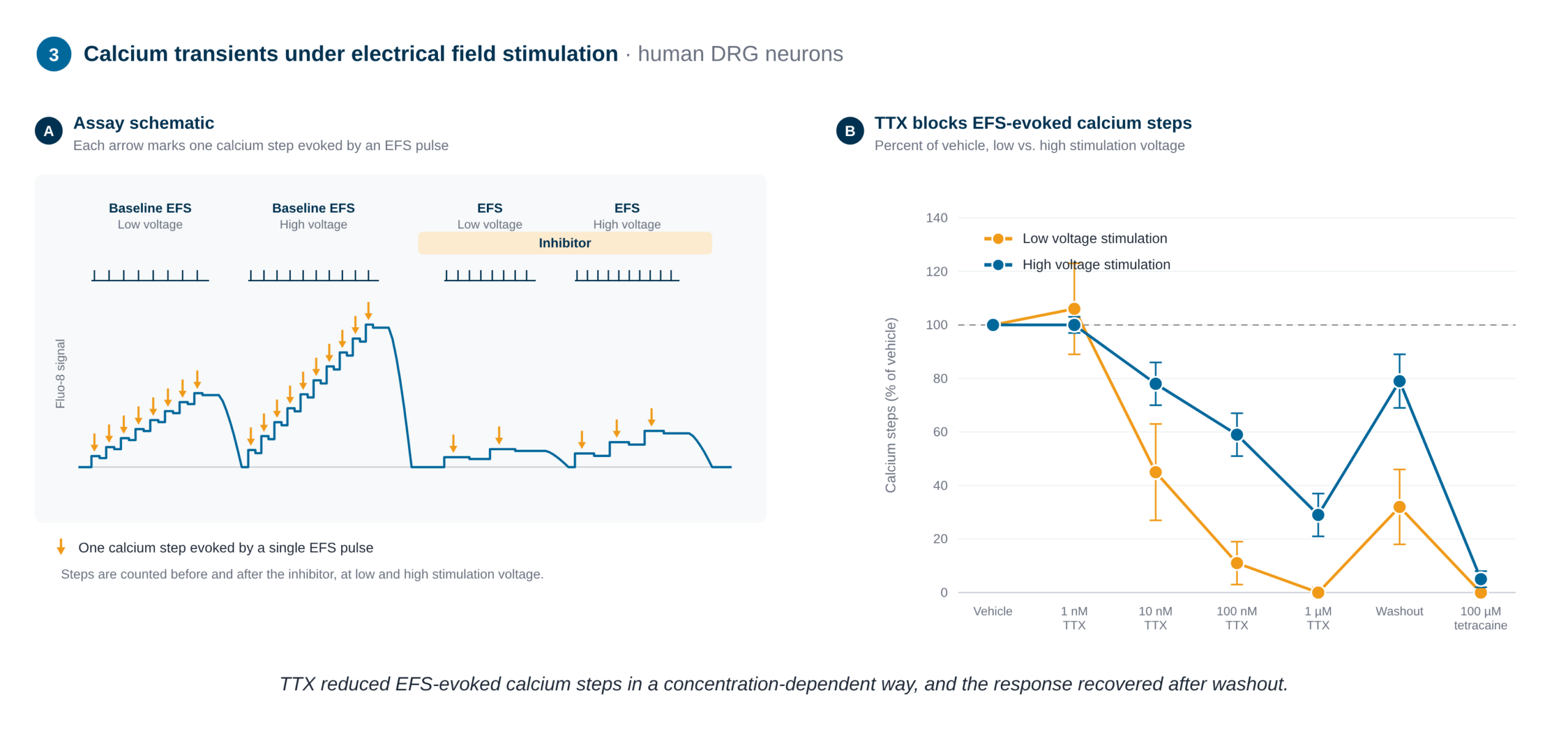
Neurons loaded with Fluo-8 are stimulated electrically, and calcium steps are counted before and after compound addition. TTX reduced steps in a concentration-dependent way at both low and high stimulation voltage, with recovery after washout.
FIGURE 4
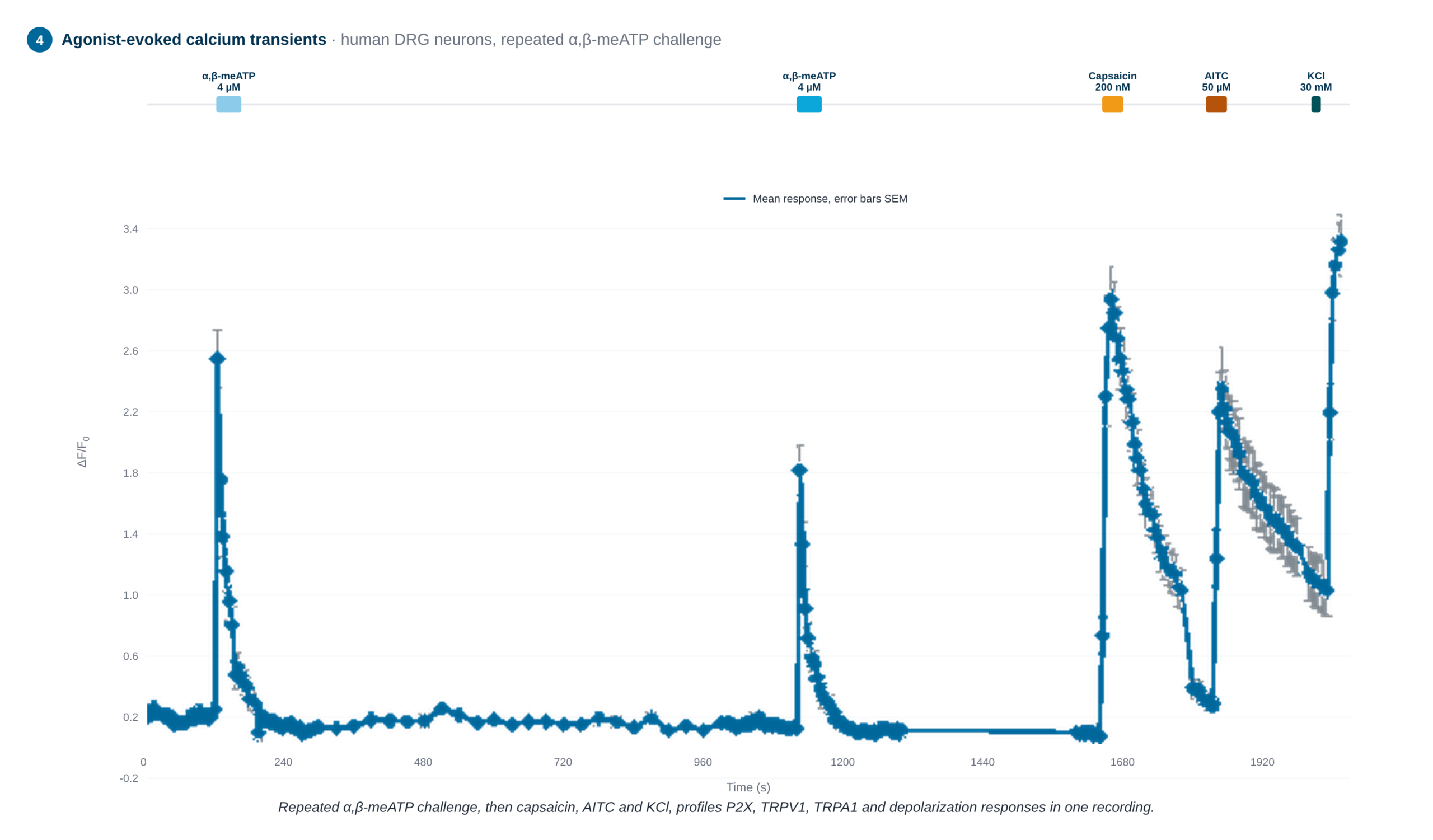
A single recording profiles responses to repeated α,β-meATP challenge, then capsaicin, AITC and KCl. Calcium transients show how a compound changes excitability without a patch pipette on every cell.
STANDARD CONFIGURATIONS
STUDY DESIGN
3 Formats
Analysis covers rheobase, resting membrane potential, capacitance and action potential counts at each frequency and concentration.
RECORDING CONDITIONS
METHODS
Every study runs on recovered human donor tissue under a documented protocol, so results can be compared across compounds and donors.
Faster identification and validation of pain and CNS therapeutics.
Direct measurement of functional responses in human DRG and spinal cord tissue.
Details on effects on ion channels and neuronal excitability.
Earlier prediction of clinical outcomes using human data.
Test NaV1.8-targeted inhibitors and other non-opioid candidates in human sensory neurons.
Confirm block of TTX-resistant sodium currents and other ionic currents in human DRG.
Measure action potential firing, rheobase and resting membrane potential under drug.
Run assays with prostaglandin E2 and bradykinin to model inflammatory sensitization.
Use oxaliplatin formats to study neuropathy driven by chemotherapy.
Compare candidates against carbamazepine, PF-05089771 or another reference compound.
WHITE PAPER
Non-opioid pain management through targeted NaV1.8 inhibition, including suzetrigine and LTGO-33.
Download the White PaperHUMAN TISSUE
Dorsal root ganglion neurons from recovered human donors for your own lab.
Explore DRG NeuronsSCOPE YOUR STUDY
Share your compound and endpoints, and we will recommend an assay format.
Schedule a ConsultationManual patch clamp electrophysiology for action potential firing and ionic currents, and calcium imaging paired with electrical field stimulation for excitability.
Action potential firing rate and characteristics, rheobase, resting membrane potential and capacitance, plus recorded ionic currents such as TTX-resistant sodium current.
Current clamp with 3 concentrations across 0.1, 1, 3 and 10 Hz in 10 cells; ramp current clamp with 3 concentrations in 10 cells; and voltage clamp with 3 concentrations plus a hammer concentration in 5 cells.
Yes. Formats include prostaglandin E2 with bradykinin for inflammatory sensitization and oxaliplatin for chemotherapy-induced neuropathy.
Donor DRG are procured surgically and shipped in neuroplegic solution, cleaned of connective tissue and fat, enzymatically digested and cultured. Recordings are made in the first 8 days in vitro.
Signals are filtered at 3 kHz and sampled at 10 kHz. Sodium currents are elicited with a 50 ms pulse from a −80 mV holding potential with a 10-second inter-stimulus interval. Test agents are dissolved in DMSO at 0.1% final concentration.
Yes. NaV1.8-targeted inhibitors are a common target class. Our white paper covers suzetrigine and LTGO-33.
Yes. We tailor format, concentrations, frequencies and endpoints to your compound. Schedule a consultation to scope your study.
PAIN AND CNS DRUG DISCOVERY
Tell us your target and compounds. We will recommend an assay format, run the study and report what the human neurons show.
Target, concentrations and the endpoints you need.
Current clamp, ramp or voltage clamp, with sensitized conditions if needed.
Firing, current and calcium transient results from human DRG neurons.