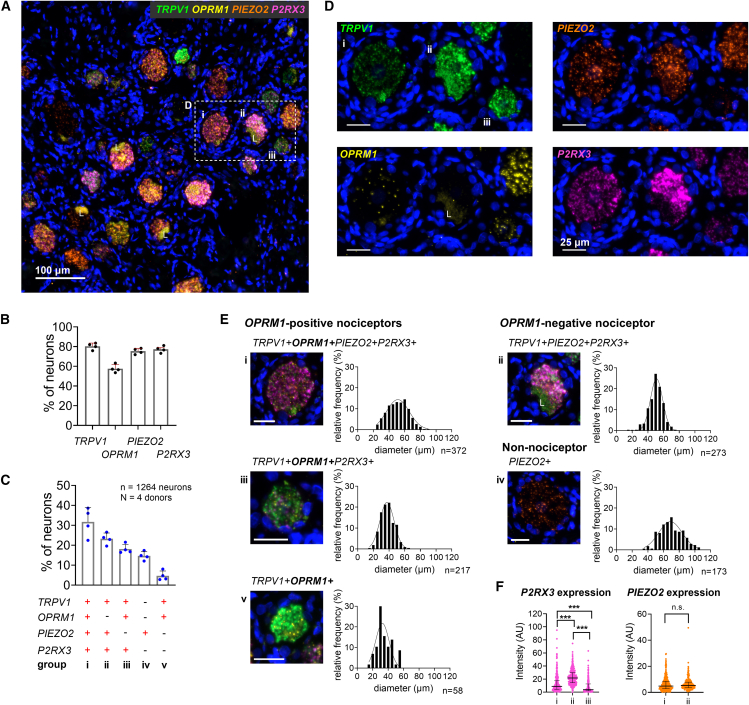
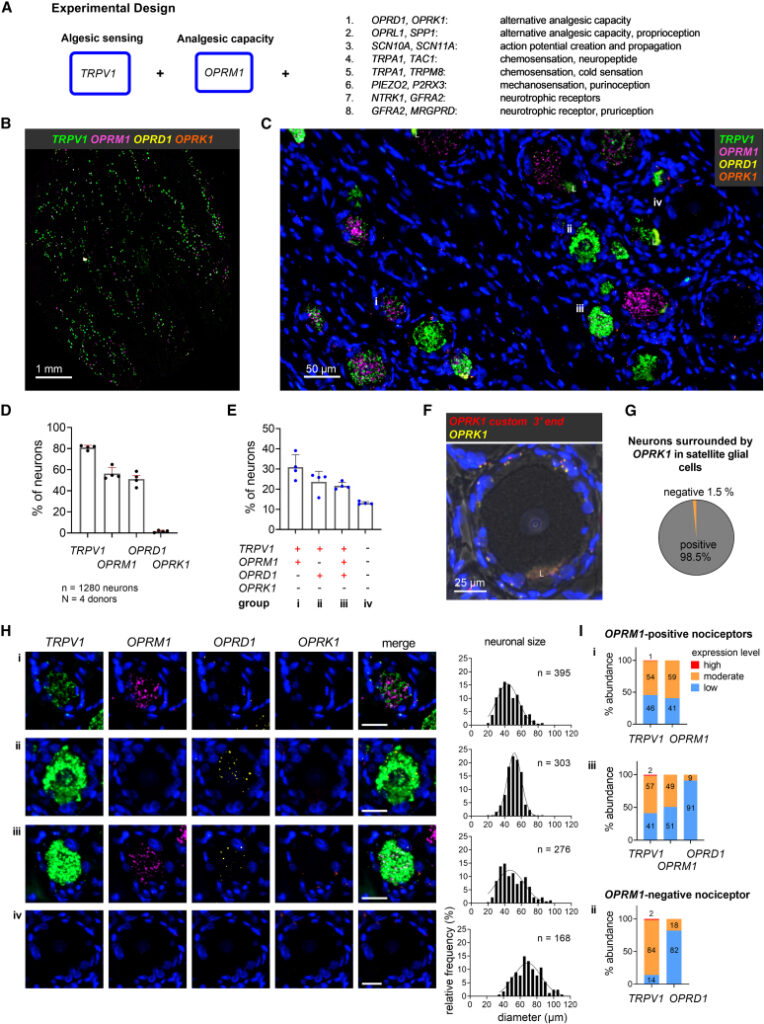
Reducing reliance on opioids for severe pain requires knowing exactly which human sensory neurons respond to μ-opioid signaling. Using multiplex in situ hybridization, we mapped OPRM1 co-expression with nociceptive channels and the δ- and κ-opioid receptors in human nociceptive afferents, revealing two molecularly distinct populations: an OPRM1-positive group resembling rodent peptidergic C-nociceptors tied to tissue-damage pain, and an OPRM1-negative group aligned with non-peptidergic C-nociceptors. This distinction — invisible without direct molecular profiling — gives drug discovery teams a human-validated framework for designing more targeted, opioid-sparing analgesics.
PUBLICATION: Cell Reports Medicine (2024)
AUTHORS: Ellen Staedtler, Matthew Sapio, Diana King, Andre Ghetti, et al.