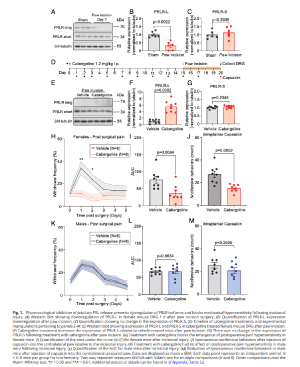
Psychological stress before surgery is a known risk factor for increased and prolonged postoperative pain, particularly in women — yet the underlying mechanisms have remained poorly understood. This study identifies prolactin (PRL), a stress- and estrogen-regulated neurohormone, as a key driver of this effect, showing that it selectively sensitizes pain-sensing neurons (nociceptors) in females across multiple species, including humans, pointing to an evolutionarily conserved mechanism with strong therapeutic relevance. In female mice, stress was shown to shift prolactin signaling in a way that amplifies nociceptor excitability, and this effect could be blocked through several targeted interventions — including a newly developed monoclonal antibody, PL200,019, which prevented prolactin-induced sensitization of human female nociceptors. In humanized mouse models, this antibody successfully suppressed both stress- and surgery-induced pain hypersensitivity. These findings suggest that preemptively targeting prolactin signaling in women prior to surgery could meaningfully reduce postoperative pain, lower reliance on opioids, and decrease the likelihood of developing chronic pain — representing a potentially important and sex-specific advance in perioperative care.
PUBLICATION: Proceedings of the National Academy of Sciences (2025)
AUTHORS: Harrison Stratton, Andre Ghetti, Stephanie Maciuba, Edel Edorh, et al.