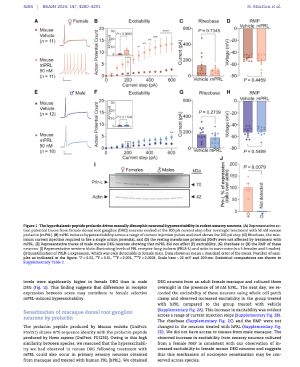
Pain conditions frequently differ between men and women not just in prevalence, but in the underlying biological mechanisms — yet sex as a variable remains largely overlooked in pain therapy and clinical trial design. This study reveals a striking functional double dissociation in how pain-sensing neurons (nociceptors) are sensitized by sex: prolactin selectively sensitizes dorsal root ganglion neurons in females, while orexin B selectively sensitizes those in males — a pattern consistently observed across mice, non-human primates, and humans, suggesting an evolutionarily conserved mechanism directly relevant to human pain. Receptor expression profiling in both cultured human sensory neurons and intact dorsal root ganglia further supported these findings, with prolactin receptor predominating in females and orexin receptor 2 in males. To the authors’ knowledge, this represents the first demonstration of functional sexual dimorphism in human sensory neurons. These discoveries carry significant implications for precision medicine, suggesting that sex-specific targeting of pain pathways could meaningfully improve therapeutic outcomes — and that both future clinical trial design and retrospective analysis of past failed trials should account for patient sex as a critical biological variable.
PUBLICATION: Brain (2024)
AUTHORS: Harrison Stratton, Andre Ghetti, Tamara Cotta, Xu Yue, Stefanie Mitchell, Grace Lee, et al.