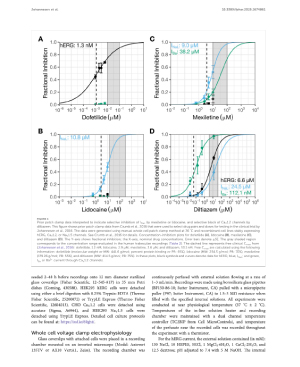
A promising strategy for counteracting dangerous drug-induced QTc prolongation — a marker of arrhythmia risk — involves co-administering agents that inhibit the late sodium current (INaL) or L-type calcium current (ICaL) alongside hERG-blocking drugs. While a clinical trial confirmed that INaL inhibitors lidocaine and mexiletine successfully shortened hERG-mediated QTc prolongation, the ICaL inhibitor diltiazem unexpectedly failed to do the same. This study set out to understand why, reexamining the ion channel pharmacology of all drugs involved using physiologically relevant patch-clamp protocols and ventricular tissue from adult human hearts. The findings revealed that diltiazem’s potency against ICaL had been significantly overestimated in prior studies, and that its concomitant hERG-blocking activity at clinical exposure levels likely negated any QTc-shortening benefit. In contrast, nifedipine — which selectively inhibits ICaL with minimal hERG activity — produced clean action potential shortening without the distortion seen with diltiazem, further supporting this interpretation. Together, these results clarify the mechanistic basis of the clinical trial outcomes and reinforce the importance of using physiologically relevant experimental protocols and human cardiac tissue when generating ion channel data intended to inform clinical cardiac safety decisions.
PUBLICATION: Frontiers in Pharmacology (2025)
AUTHORS: Lars Johannesen, Najah Abi-Gerges, Katrina Sweat, Guy Page, Claudia Alvarez Baron, Huimei Yu, Wendy Wu, et al.